How TPF works.
Every hybrid athlete hits the same wall: the conditioning starts cutting into the lifting, or the lifting stalls the running, and the apps can’t tell you why. TPF Hybrid runs on real exercise science — how runs, rows and metcons add up across energy systems, how lifting and conditioning compete for the same recovery, how Monday’s leg day shows up in Thursday’s tempo. None of it is guessed, and all of it is visible while you plan. The science does the counting. The calls that matter stay with you.
The principles are few.
Hybrid training isn’t a mystery. Apply the right stimulus, recover, push the load up, keep showing up. Four principles. The methods built from them are infinite — the principles themselves barely change.
Most of what you read online is over-simplified, misapplied, or made artificially black-and-white. That’s where most athletes get stuck. TPF encodes the principles. You pick the methods.
How we know it works.
Every engine component is checked three ways.
- 1
Against the research. Every formula and weighting traces back to peer-reviewed work on stimulus, recovery, periodisation, and energy-system physiology. The papers are listed in full at the foot of this page — read them, argue with them, hold us to them.
- 2
Against real coaching practice. We run mainstream protocols — 5/3/1, RP-style hypertrophy, Norwegian 4×4, Daniels marathon plans — through the engine and verify the outputs match what those protocols are known to produce in practice.
- 3
Against the maths. Worked examples computed by hand. If the engine drifts from the closed-form answer, we investigate and recalibrate — or document why the model deliberately disagrees.
Alerts flag. You decide.
Set a goal — a race, a standard, a number — and the engine checks the plan you build against it. When the plan drifts from the goal, you’re told, and the alert points at the scored numbers behind it — the same volume, recovery and energy-system models on this page.
No alert changes your plan. You see the evidence; you make the call. Be your own expert.
What the engine does.
Intensity & load
Every prescription carries a target intensity, not just sets and reps — a percentage of your 1RM on the lifts, and a target pace on the runs and intervals. Where the app doesn’t have your 1RM or race pace on file yet, it suggests one from the rep range and the prescribed reps-in-reserve. So the load is never left to guesswork: you train at the intensity the adaptation needs — heavy enough to drive the stimulus, not so light that the session fails to earn it.
Strength & hypertrophy
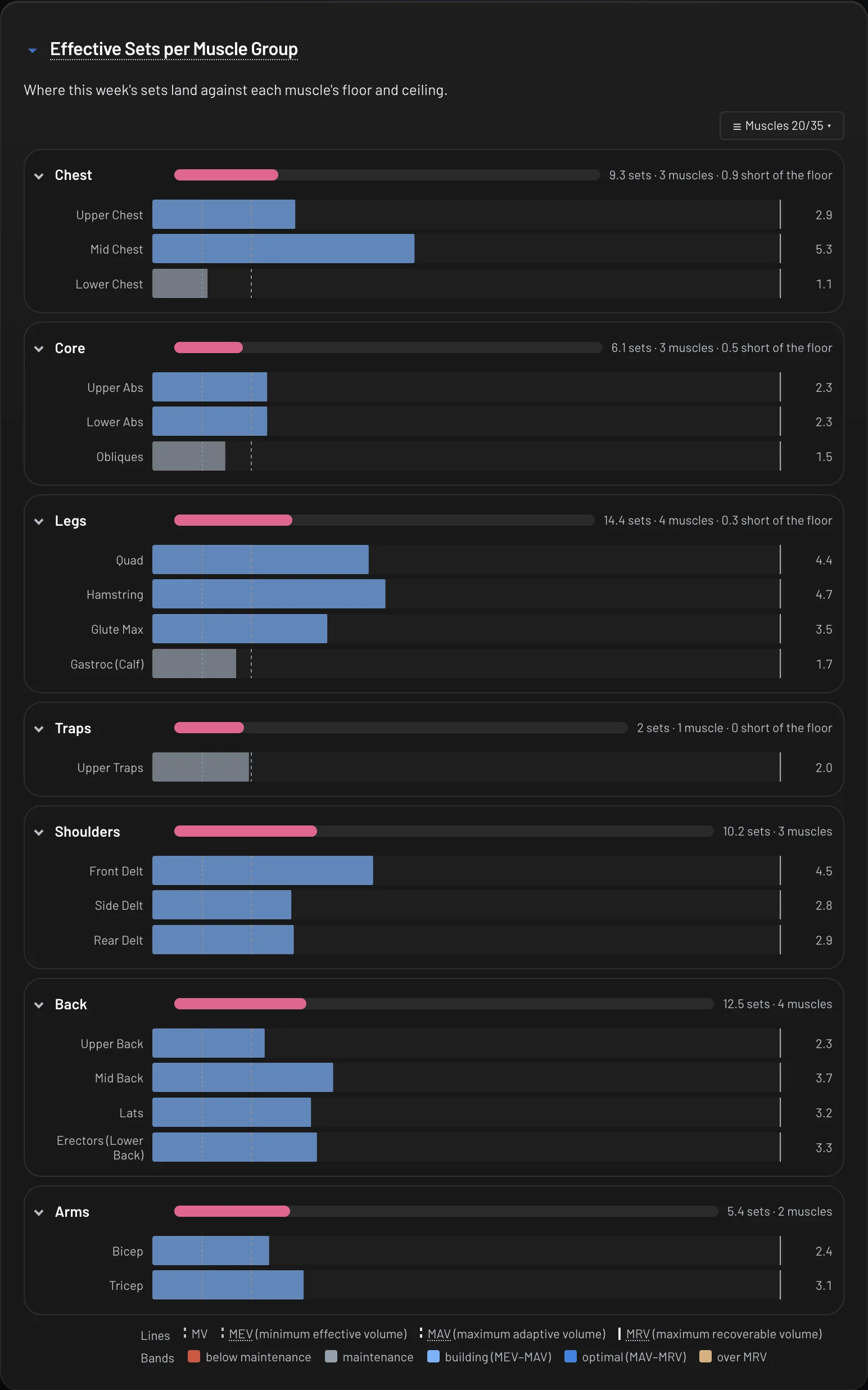
The TPF Effective Sets™ system credits every working set on what actually drives growth — how close to failure you went, how heavy you lifted, how long you rested, and which muscles the lift really trains. Compounds count differently from isolation. Stretch position counts differently from short. Volume landmarks — the floor, the sweet spot, the ceiling — are tuned to your training age, not pulled from a textbook average.
Strength and hypertrophy don’t grow on the same curve. The engine knows it — separate dose-response models for each, anchored to Schoenfeld 2017 (hypertrophy) and Ralston 2017 (strength), scaled to your experience level. For hybrid loads the strength volume is intentionally held lower so the conditioning can live in the same week without one cannibalising the other.
Seven intensity techniques — cluster sets, myo-rep match, rest-pause, lengthened partials, 1¼ reps, drop sets, and straight sets — are each scored for what they stimulate and what they cost, not counted as plain sets.
Recovery cost
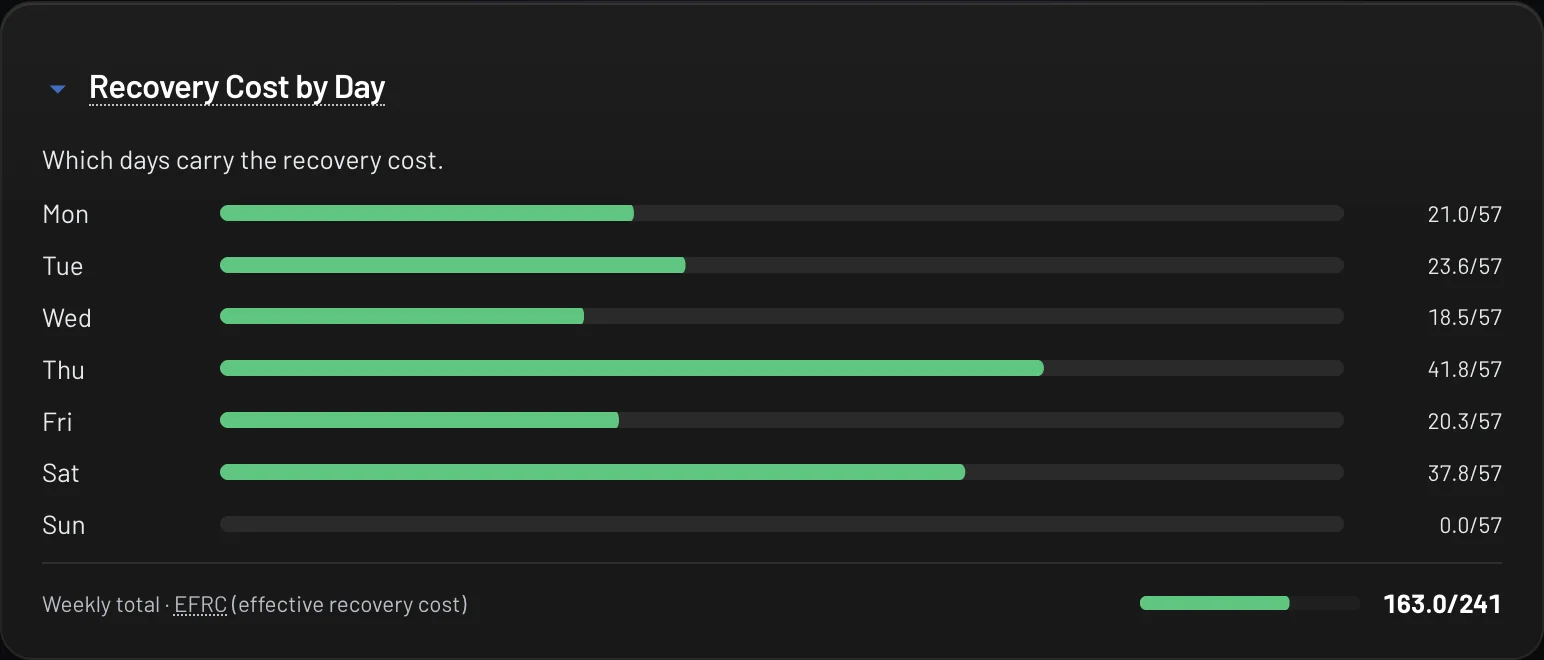
Every set adds to a running fatigue total, weighed against the capacity that comes with your training age. Daily and weekly views colour the picture green, amber, red — sustainable, high, over the line. Built on the Banister fitness-fatigue model (1991), the Vanrenterghem two-pathway fatigue framework (2017), and the Foster session-RPE literature (2001+). Conditioning lands on the same scale as strength — a hard interval block or a long endurance session sits next to a heavy squat day, weighted on the same terms. Nothing is scored in isolation.
Conditioning
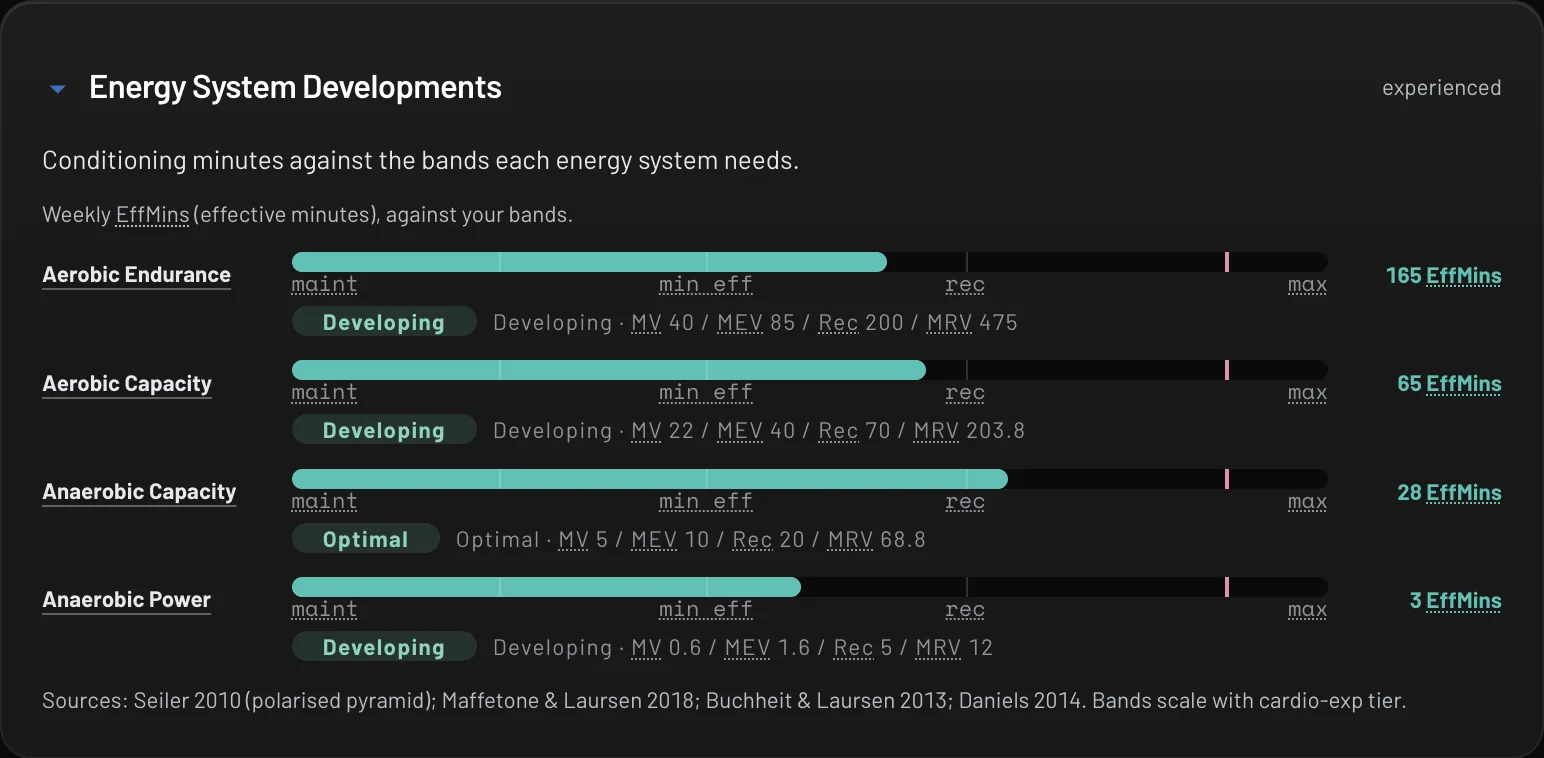
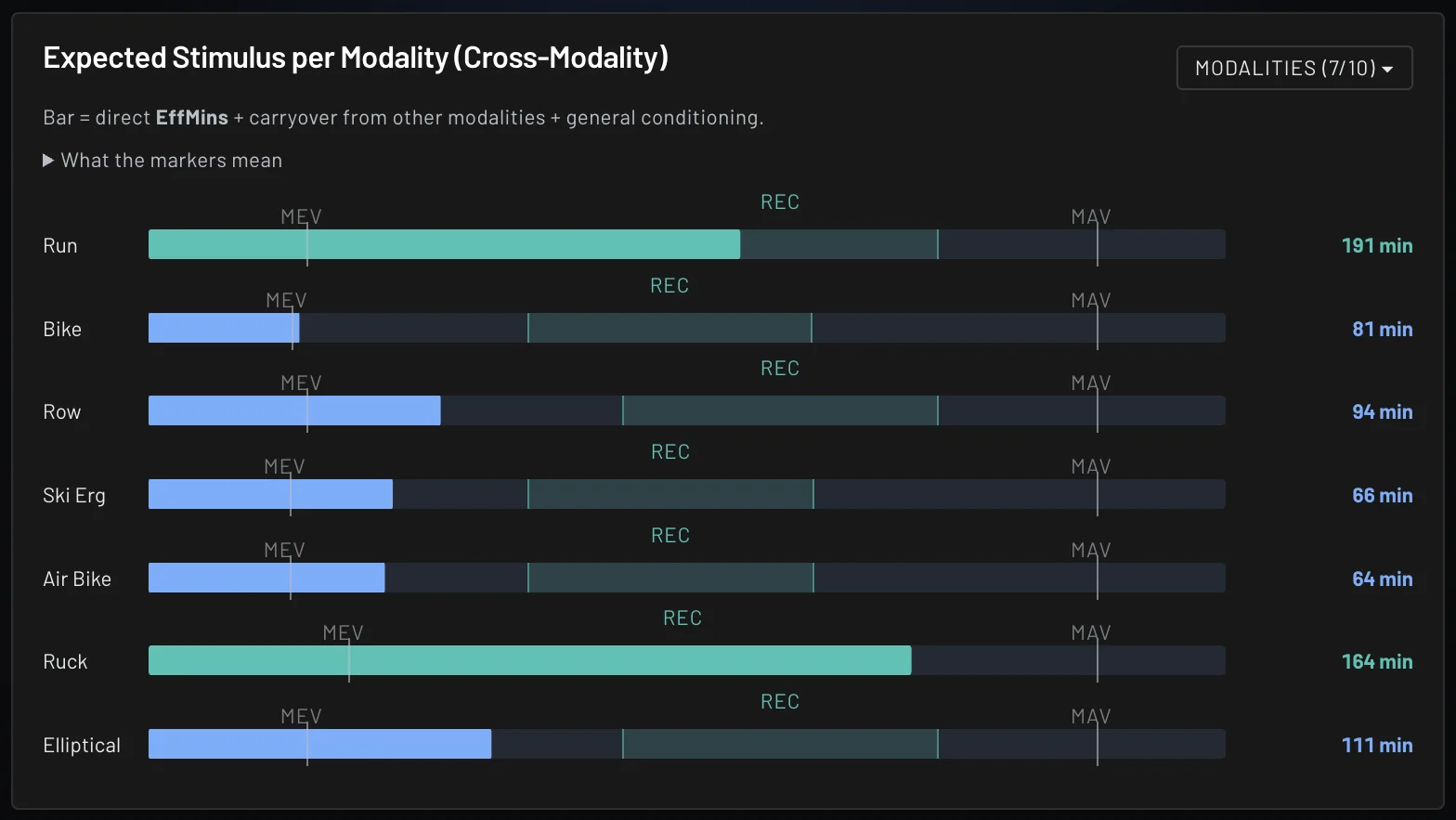
Every conditioning session lands across four energy systems — aerobic endurance, aerobic capacity, anaerobic capacity, anaerobic power — because a Z2 ride and a Tabata block train different things and deserve different credit. TPF Effective Mins is the unit: a minute counts for more as the work zone gets harder, and the rests, the reps and the after-burn all count. Built on the Edwards TRIMP framework and the Buchheit & Laursen interval-programming work.
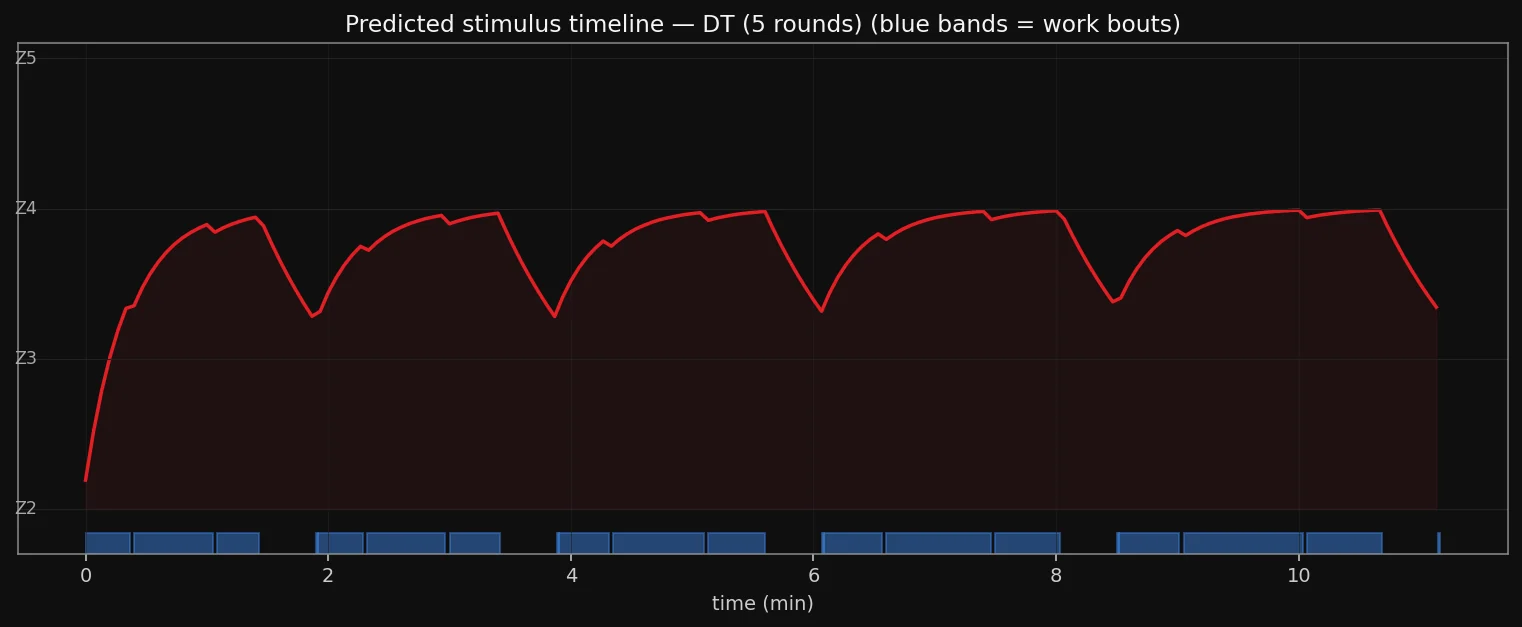
Runs score by zone and duration. Easy mileage builds the base; tempo and threshold work hits the middle; intervals and race-pace efforts push the top end. Each rep is scored by what’s happening metabolically inside it, not by its RPE tag alone. Rucking is scored as aerobic endurance with the load counted — heavier kit at the same pace costs more and stimulates more.
Seven of the most-used conditioning protocols — Norwegian 4×4, Tabata, MAF Z2, Yasso 800s, hard continuous intervals, Cardiac Output Method, 5K race-pace work — are pre-validated against the engine. If your block matches one of these, you can trust the dose-response.
Race paces come from VDOT (Daniels 2014): one logged race or time trial sets your training paces and reports the tier you have reached.
The cross-over
Lifting and conditioning compete for the same recovery. Heavy cardio before heavy strength dulls the strength adaptation — the engine knows it and tells you when your session order is fighting you. The interference effect is modelled per Wilson 2012 and Schumann 2022.
Fatigue doesn’t reset at midnight. Monday’s long ruck still hangs on your legs Tuesday morning. Wednesday’s intervals show up in Thursday’s tempo run. Nothing in the week is scored alone — the engine sees the whole picture.
What we don’t claim.
We don't predict injury. We flag sudden spikes in load. We don’t pretend to know when you’re going to get hurt — the evidence for that just isn’t strong enough.
We don't replace a coach. A coach who knows you, your life, your stress, and your technique is irreplaceable. Use both if you can.
We don't model what we can't see. Sleep, food, life stress, technique, genetics — those stay with you. You know your own context better than any app does.
The plan that works is the one you’ll stick to.
TPF Hybrid hands you the engine and steps back. Build the week that fits your race calendar, your box’s programming, your kit. The science counts the load. The calls stay with you.
Be your own expert.
The science underneath.
Every curve, weighting, and dose-response in the engine traces back to a paper. Below: the principal sources, by domain. Each title links to the paper via Google Scholar — read it yourself.
Named protocols (Norwegian 4×4, Tabata, Yasso 800s, MAF, Cardiac Output Method, etc.) are cited for methodology comparison only — their inclusion doesn’t imply endorsement of TPF by the original authors or rights-holders.
Volume & dose-response
- Ralston GW, Kilgore L, Wyatt FB, Baker JS (2017). The effect of weekly set volume on strength gain: a meta-analysis. Sports Medicine 47(12).
- Schoenfeld BJ, Ogborn D, Krieger JW (2017). Dose-response relationship between weekly resistance training volume and increases in muscle mass: a systematic review and meta-analysis. Journal of Sports Sciences.
- Schoenfeld BJ (2010). The mechanisms of muscle hypertrophy and their application to resistance training. Journal of Strength and Conditioning Research.
- Krieger JW (2010). Single vs. multiple sets of resistance exercise for muscle hypertrophy: a meta-analysis. Journal of Strength and Conditioning Research.
- Krieger JW (2009). Single vs. multiple sets of resistance exercises for muscle strength: a meta-analysis. Journal of Strength and Conditioning Research 23(6).
- Rhea MR, Alvar BA, Burkett LN, Ball SD (2003). A meta-analysis to determine the dose response for strength development. Medicine & Science in Sports & Exercise.
- Heaselgrave SR, Blacker J, Smeuninx B, McKendry J, Breen L (2018). Dose-response relationship of weekly resistance-training volume and frequency on muscular adaptations in trained men. International Journal of Sports Physiology and Performance.
- Brigatto FA, et al. (2019). Effect of resistance training volume on hypertrophy and 1RM strength in trained men. Journal of Strength and Conditioning Research.
- Israetel M, Hoffmann J, Smith C (2021). Scientific Principles of Hypertrophy Training. Renaissance Periodization.
- Helms ER, Aragon AA, Fitschen PJ (2018). The Muscle and Strength Pyramid: Training (2nd ed.).
- Schoenfeld BJ, Contreras B, Krieger J, et al. (2019). Resistance training volume enhances muscle hypertrophy but not strength in trained men. Medicine & Science in Sports & Exercise 51(1).
- Mangine GT, et al. (2015). The effect of training volume and intensity on improvements in muscular strength and size in resistance-trained men. Physiological Reports 3(8).
- Morton RW, et al. (2016). Neither load nor systemic hormones determine resistance training-mediated hypertrophy or strength gains in resistance-trained young men. Journal of Applied Physiology 121(1).
Proximity to failure & load
- Refalo MC, et al. (2023). Influence of resistance training proximity-to-failure on skeletal muscle hypertrophy. Journal of Sports Sciences.
- Robinson ZP, et al. (2024). Exploring the dose-response relationship between estimated resistance training proximity to failure, strength gain, and muscle hypertrophy. Journal of Strength and Conditioning Research.
- Helms ER, et al. (2018). RPE and velocity loss as autoregulation tools in resistance training. Sports Medicine 48(4).
- Pareja-Blanco F, et al. (2017). Effects of velocity loss during resistance training on athletic performance, strength gains and muscle adaptations. Scandinavian Journal of Medicine & Science in Sports.
- Lasevicius T, et al. (2018). Effects of different intensities of resistance training with equated volume load on muscle strength and hypertrophy. European Journal of Sport Science 18(6).
- Zourdos MC, et al. (2016). Novel resistance training-specific RPE scale measuring repetitions in reserve. Journal of Strength and Conditioning Research 30(1).
- Helms ER, et al. (2016). RPE-based training in a competitive powerlifting sample. Journal of Fitness Research 5(2).
- Carroll KM, et al. (2019). Visual feedback of training-load to improve velocity-load relationship. Journal of Strength and Conditioning Research 33(7).
- Fry AC (2004). The role of resistance exercise intensity on muscle fibre adaptations. Sports Medicine 34(10).
- Spiering BA, et al. (2008). Resistance exercise biology: manipulation of resistance exercise programme variables determines the responses of cellular and molecular signalling pathways. Sports Medicine 38(7).
Stretched position & lengthened partials
- Kassiano W, et al. (2022). Resistance training in the lengthened position induces greater muscle hypertrophy than the shortened position. Medicine & Science in Sports & Exercise.
- Kassiano W, et al. (2023). Bigger gains in the lengthened biceps: position-specific hypertrophy training. Medicine & Science in Sports & Exercise.
- Wolf M, et al. (2024). Partial vs. full range of motion resistance training: a meta-analysis on hypertrophic adaptations. Sports Medicine.
- Maeo S, et al. (2022). Greater hamstring muscle hypertrophy from lengthened-bias training. Medicine & Science in Sports & Exercise 54(11).
- Maeo S, et al. (2025). Longer muscles get stronger: partial ROM training in the lengthened position. Frontiers in Physiology.
Intensity techniques
- Fagerli B (2010). Myo-Reps: a method to maximise time-efficient hypertrophy. Original protocol publication.
- Bjørnsen T, et al. (2019). Type 1 muscle fibre hypertrophy after blood flow-restricted training in powerlifters. Medicine & Science in Sports & Exercise.
- Tufano JJ, et al. (2017). Cluster sets vs. traditional sets for resistance training. Journal of Strength and Conditioning Research 31(3).
- Prestes J, et al. (2019). Strength and muscular adaptations after 6 weeks of rest-pause vs. traditional multiple-sets resistance training. Journal of Strength and Conditioning Research.
- Karimifard S, et al. (2023). Rest-pause resistance training promotes greater strength and muscle size gains than traditional sets. Journal of Sports Medicine and Physical Fitness.
- Beardsley C, Schoenfeld BJ (2018). Myo-reps and training-to-failure for hypertrophy. Strength & Conditioning Journal.
Inter-set rest
- Singer EA, et al. (2024). Effect of inter-set rest interval on resistance training-induced adaptations: meta-analysis. European Journal of Applied Physiology.
- Schoenfeld BJ, et al. (2016). Longer inter-set rest periods enhance muscle strength and hypertrophy in resistance-trained men. Journal of Strength and Conditioning Research 30(7).
- de Salles BF, et al. (2009). Rest interval between sets in strength training. Sports Medicine 39(9).
- Henselmans M, Schoenfeld BJ (2014). The effect of inter-set rest intervals on resistance exercise-induced muscle hypertrophy. Sports Medicine 44(12).
Programming & periodisation
- Schoenfeld BJ, Grgic J, Krieger JW (2017). How many times per week should a muscle be trained to maximise muscle hypertrophy? A meta-analysis of studies examining training frequency. Sports Medicine 47(12).
- Helms ER, Morgan A, Valdez A (2019). The Muscle and Strength Pyramid: Training (2nd ed.).
- Helms ER, et al. (2014). Recommendations for natural bodybuilding contest preparation: resistance and cardiovascular training. Journal of Sports Medicine and Physical Fitness.
- Israetel M, Hoffmann J (2017). How Much Should I Train? — MEV / MAV / MRV volume-landmark framework. Renaissance Periodization.
- Galpin AJ (2022). Lecture series on recovery, adaptation, and periodisation. Absolute Rest.
- Norton L (2020). The Complete Contest Prep Guide. BioLayne LLC.
- Barakat C, et al. (2020). Body Recomposition: Can Trained Individuals Build Muscle and Lose Fat at the Same Time? Strength & Conditioning Journal 42(5).
Conditioning & energy-systems physiology
- Jamieson J (2009). Ultimate MMA Conditioning. 8WeeksOut.
- Galpin AJ × Huberman Lab guest series (2022, 2023). Strength, hypertrophy, endurance, fatigue, recovery.
- Helgerud J, et al. (2007). Aerobic high-intensity intervals improve VO2max more than moderate training. Medicine & Science in Sports & Exercise 39(4).
- Tabata I, et al. (1996). Effects of moderate-intensity endurance and high-intensity intermittent training on anaerobic capacity and VO2max. Medicine & Science in Sports & Exercise 28(10).
- Buchheit M, Laursen PB (2013). High-intensity interval training: solutions to the programming puzzle (Parts I + II). Sports Medicine 43(5) and 43(10).
- Laursen PB, Buchheit M (2019). Science and Application of High-Intensity Interval Training. Human Kinetics.
- Daniels J (2014). Daniels' Running Formula (3rd ed.). Human Kinetics.
- Seiler S (2010). What is best practice for training intensity and duration distribution in endurance athletes? International Journal of Sports Physiology and Performance 5(3).
- Stöggl T, Sperlich B (2014). Polarised training has greater impact on key endurance variables than threshold, high-intensity, or high-volume training. Frontiers in Physiology 5:33.
- MacInnis MJ, Gibala MJ (2017). Physiological adaptations to interval training and the role of exercise intensity. Journal of Physiology 595(9).
- Milanović Z, et al. (2015). Effectiveness of HIIT vs. continuous endurance training for VO2max improvements: a systematic review and meta-analysis. Sports Medicine 45(10).
- Gist NH, et al. (2014). Sprint interval training effects on aerobic capacity: a systematic review. Sports Medicine 44(2).
- Joyner MJ, Coyle EF (2008). Endurance exercise performance: the physiology of champions. Journal of Physiology 586(1).
- Bishop D, Edge J (2006). Determinants of repeated-sprint ability. European Journal of Applied Physiology 97(4).
- Brooks GA (2018). The science and translation of lactate shuttle theory. Cell Metabolism 27(4).
- Coggan AR, Allen H (2010). Training and Racing with a Power Meter.
Training load & recovery models
- Banister EW (1991). Modeling elite athletic performance. In: Physiological Testing of the High-Performance Athlete (2nd ed.).
- Banister EW, Calvert TW (1980). Planning for future performance: implications for long-term training. Canadian Journal of Applied Sport Sciences 5(3).
- Edwards S (1993). The Heart Rate Monitor Book — five-zone TRIMP framework.
- Foster C, et al. (2001). A new approach to monitoring exercise training (session-RPE). JSCR 15(1) / MSSE 33(9).
- Williams S, West S, Cross MJ, Stokes KA (2017). A better way to determine the acute:chronic workload ratio? — EWMA formulation. British Journal of Sports Medicine 51(3).
- Busso T (2003). Variable dose-response relationship between exercise training and performance. Medicine & Science in Sports & Exercise 35(7).
- Vanrenterghem J, et al. (2017). Training load monitoring in team sports: a novel framework separating physiological and biomechanical load-adaptation pathways. Sports Medicine 47(11).
Concurrent training & EPOC
- Hickson RC (1980). Interference of strength development by simultaneously training for strength and endurance. European Journal of Applied Physiology 45(2-3).
- Wilson JM, et al. (2012). Concurrent training: a meta-analysis of interference effects between aerobic and resistance exercise. Journal of Strength and Conditioning Research 26(8).
- Schumann M, et al. (2022). Compatibility of concurrent aerobic and strength training for skeletal muscle size and function: an updated systematic review and meta-analysis. Sports Medicine 52(3).
- Coffey VG, Hawley JA (2017). Concurrent exercise training: do opposites distract? Journal of Physiology 595(9).
- Børsheim E, Bahr R (2003). Effect of exercise intensity, duration and mode on post-exercise oxygen consumption. Sports Medicine 33(14).
- LaForgia J, Withers RT, Gore CJ (2006). Effects of exercise intensity and duration on the excess post-exercise oxygen consumption. Journal of Sports Sciences 24(12).
- Knab AM, et al. (2011). A 45-minute vigorous exercise bout increases metabolic rate for 14 hours. Medicine & Science in Sports & Exercise 43(9).
1RM estimation
Injury risk & load monitoring (caveated)
- Gabbett TJ (2016). The training-injury prevention paradox: should athletes be training smarter and harder? British Journal of Sports Medicine 50(5).
- Impellizzeri FM, et al. (2020). Acute:chronic workload ratio: conceptual issues and fundamental pitfalls. British Journal of Sports Medicine.
Every value and formula is version-controlled and documented internally. The specific weightings, multipliers, and per-exercise calibrations stay with TPF.
Coach, sport scientist, or just curious? Reach out via the contact link in the footer.